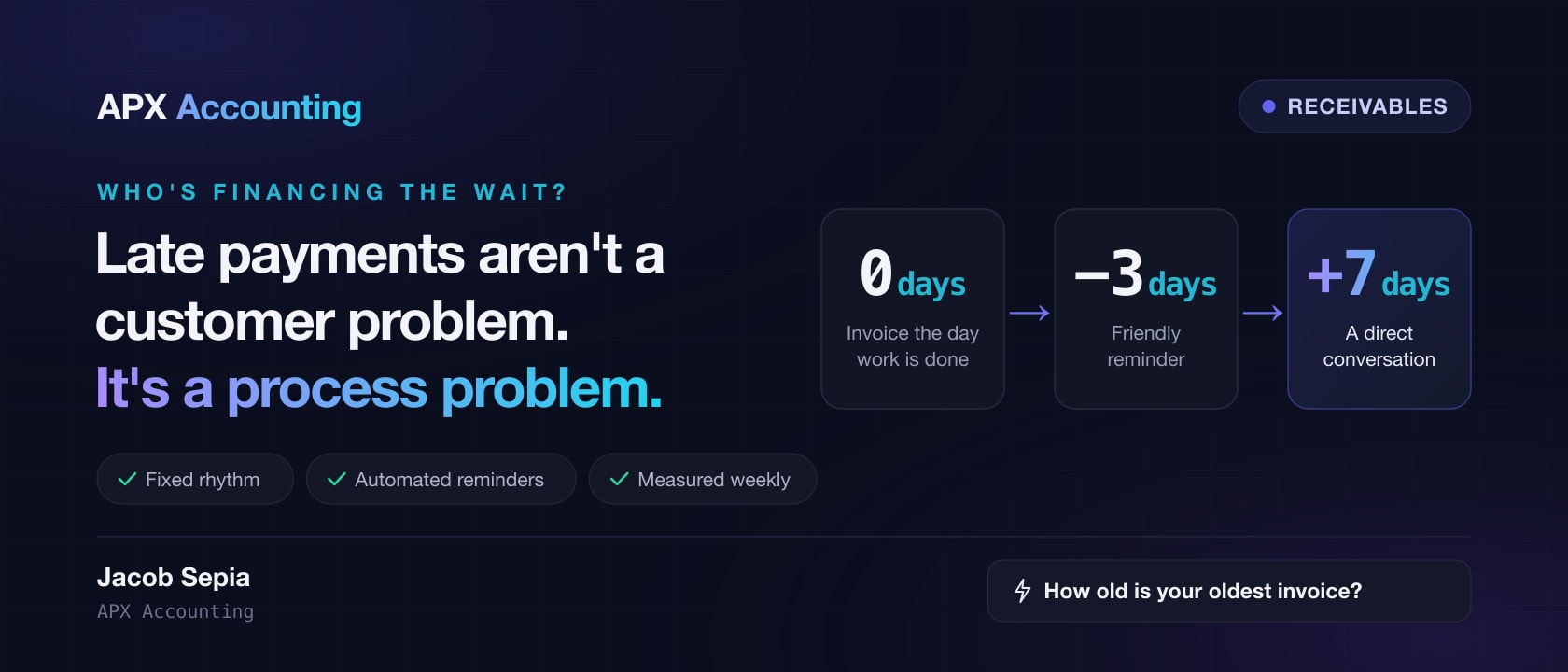
Your customers are not short on money. They're short on urgency, and your business is the one financing the wait.
Every invoice that sits unpaid past its due date is an interest-free loan from you to your customer. Nobody signed a loan agreement. Nobody approved it. It just happened, one late invoice at a time, until a meaningful chunk of your working capital is sitting in other people's bank accounts.
And when cash gets tight, too many owners do the most expensive thing possible: they borrow against a line of credit, or pay fees to a financing platform, to access money they've already earned. That's paying interest to borrow your own revenue back.
Late Payment Is Rarely a Customer Problem
When I look at a business with a receivables problem, I almost never find a list of bad customers. I find a process problem. It usually looks like this:
- The invoice goes out late. The work finished on the 3rd. The invoice went out on the 19th, when someone finally got to it. The customer's 30-day clock didn't start until then.
- The terms aren't clear. The invoice says "Net 30" but the quote said "due on receipt," and the contract says something else again. When terms are fuzzy, customers default to paying whenever suits them.
- Nobody follows up on a schedule. Follow-up happens when cash is tight, not when invoices are due. So it's irregular, inconsistent, and often awkward.
- The owner is the collections department. The person who sold the work is now chasing payment for it, which is uncomfortable for everyone and easy to put off.
- Disputes surface late. The customer had a question about line three. Nobody asked them until day 45, so the invoice sat in limbo for six weeks over a ten-minute conversation.
None of those are customer problems. All of them are fixable with process.
The Quick Test
Could you say, right now, exactly how much you're owed, by whom, and how old each invoice is?
If that answer takes more than a minute, nobody owns your receivables. And whatever nobody owns gets worse over time.
The Receivables Rhythm
The fix is boring, and it works. Replace "follow up when we need cash" with a fixed rhythm that runs whether cash is tight or not. Here's the cadence we set up for clients. Adjust the timing to your terms and your industry, but keep the rhythm.
- Day 0: Invoice the day the work is done. Not at month-end. Not when someone gets to it. Every day an invoice isn't sent is a day added to how long you wait for your money.
- Three days before the due date: a friendly reminder. Not a collections notice. A courtesy: "Just a heads-up that invoice 1042 is due Friday. Here's the payment link." Most late payments are forgotten payments, and this one message prevents a surprising number of them.
- The day after the due date: a polite follow-up. Short, specific, with the invoice attached and a link to pay.
- Seven days past due: a direct conversation. An email or call from someone other than the owner, ideally whoever manages your receivables. Ask whether anything is holding up payment. This is where disputes get found and fixed early.
- Fourteen days past due: escalation. A firmer note that references your terms, including any late interest you charge.
- Thirty days past due: a business decision. Pause new work, move the customer to deposit or prepayment terms, or escalate further. This is a decision, made on purpose, not a reaction made when the bank balance gets scary.
Businesses that run this rhythm get paid faster without a single awkward phone call, because the awkwardness came from irregular, emotional follow-up. A predictable rhythm feels professional to customers. They know what to expect, and so do you.
Automate the Rhythm
Here's where most small businesses fall down: the rhythm only works if it runs every time, and people get busy. So don't rely on people for the parts a system can do.
- Automated reminders. Xero and QuickBooks Online both send scheduled invoice reminders. Set them up once with your own wording and they run before and after every due date.
- A payment link on every invoice. Card, EFT, or online banking, one click away. Every step you remove between "I should pay this" and "paid" shortens your collection time.
- Pre-authorized debit for recurring work. If you bill the same customers every month, collect automatically on the due date instead of waiting for them to remember.
- Automatic payment matching. When payments land in your bank feed and match to invoices automatically, your receivables report is accurate every morning, not just after someone spends an afternoon reconciling.
Automation handles the routine. People handle the exceptions: the dispute, the customer going through a rough patch, the large account that needs a phone call. That's the right split.
Get the Terms Right Before the Work Starts
Collections start at the quote, not the invoice.
- One set of terms, everywhere. The quote, the contract, and the invoice should all say the same thing.
- Deposits for larger work. A deposit at signing, and progress billing on milestones, keep you from financing an entire project.
- Clear late interest, stated properly. If you charge interest on overdue invoices, put it in your terms. One Canadian detail: under section 4 of the federal Interest Act, if your terms express interest as a monthly rate (say, 2% per month) without also stating the equivalent annual rate, you may be limited to collecting 5% a year. State the annual rate alongside the monthly one.
Measure It Weekly
You can't improve what you only look at when cash is tight. Look at these every week:
- Aging buckets: current, 1–30, 31–60, 61–90, and over 90 days.
- Percentage of receivables over 30 days. This is the number to watch trend down.
- Days sales outstanding (DSO): roughly, how many days of revenue are sitting in receivables.
- Your ten largest balances, with a note on each.
What It's Worth
Here's simple math for a hypothetical business with $2M in annual revenue. Each day of DSO is worth about $5,500 in cash ($2,000,000 ÷ 365). If a receivables rhythm brings DSO down from 55 days to 40, that frees up roughly $82,000 in cash. Not new revenue, just money you already earned, sitting in your bank account instead of your customers'.
That's often the difference between drawing on a line of credit and not needing one.
The Bottom Line
Revenue is only real when it becomes cash. If your receivables process depends on someone remembering to follow up when things get tight, it isn't a process. It's a hope.
Invoice the day the work is done. Remind before the due date. Follow up the day after. Escalate on a rhythm instead of when cash gets tight. Automate everything a system can do, and give one person ownership of the rest.
Our Bookkeeping service runs receivables this way for clients every week, with the reminders, payment links, and matching set up by our Tech & Automation team. If you can't answer the quick test in under a minute, book a call and we'll help you set up a rhythm.