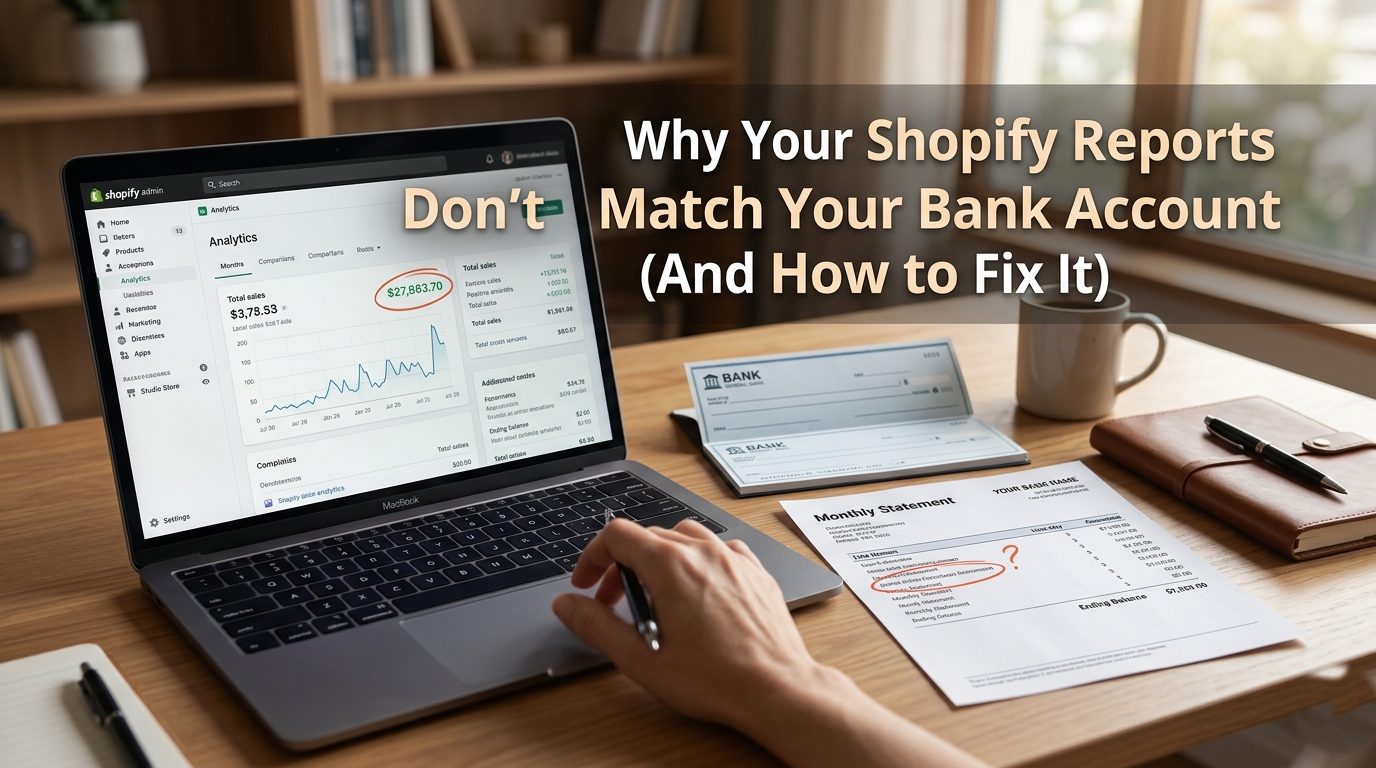
The Reconciliation Nightmare
If you run an e-commerce business on Shopify and you've ever tried to reconcile your Shopify sales reports with what actually hits your bank account, you've experienced the quiet rage that is multi-channel commerce accounting. The numbers never match. And the gap is rarely small.
Here's why: Shopify reports gross sales. Your bank receives net deposits. Between gross and net, there's a labyrinth of payment processor fees, refunds, chargebacks, gift card redemptions, currency conversion spreads, and shipping label charges that Shopify's native reporting was never designed to trace individually.
The Three Reconciliation Layers
Layer 1: Gross Revenue Recognition
Sales are recognized at the transaction level from Shopify's Orders API, not from bank deposits. Each order is booked individually with its gross amount, discount applied, tax collected, and shipping charged. This flows into the GL daily using an integration tool like A2X, which was purpose-built for e-commerce accounting.
Layer 2: Clearing Account for Deposits
Shopify payouts hit a dedicated "Shopify Clearing" bank account in your GL — not your sales account. When the daily A2X reconciliation runs, it matches each payout line item (fees, refunds, adjustments) against the original transactions, clearing the balance to zero. If the clearing account isn't at zero by month-end, there's an unmatched transaction that needs investigation.
Layer 3: Inventory Cost Sync
The third piece is COGS. Every time an order ships, the cost of the items sold needs to be moved from your Inventory asset account to your Cost of Goods Sold expense account. For most Shopify merchants doing under $5M, we recommend weighted average costing synced through an inventory management tool like Cin7 or Stocky.
The Multi-Channel Problem
If you're selling on Shopify, Amazon FBA, and your own wholesale channel, the complexity multiplies. Amazon's settlement reports are notoriously opaque — they bundle FBA fees, storage fees, advertising charges, and refunds into a single bi-weekly payout. We use A2X for both Shopify and Amazon, with separate clearing accounts for each channel. This gives you a clean, channel-level P&L.
Sales Tax: The Hidden Compliance Risk
If you're selling across provincial lines in Canada (or into the US), you likely have sales tax obligations in multiple jurisdictions. Shopify collects the tax at checkout, but it doesn't file the returns for you. In Ontario, HST collected goes on your regular GST/HST return. But if you're shipping to British Columbia (GST + PST), Saskatchewan (PST), or into US states where you have economic nexus, you need separate filings.
Next Steps
If your monthly close takes longer than 5 business days, if your gross margin on paper doesn't match what you feel in your bank account, or if you can't tell which sales channel is actually your most profitable — book a free tech stack audit and we'll map out the exact integrations your business needs.