A year ago, AI spend was an experiment tucked inside somebody's software budget. A ChatGPT seat for the founder. A free trial someone forgot to cancel.
Now it's showing up as its own line item. It grows every quarter. And in most of the companies I talk to, nobody clearly owns it.
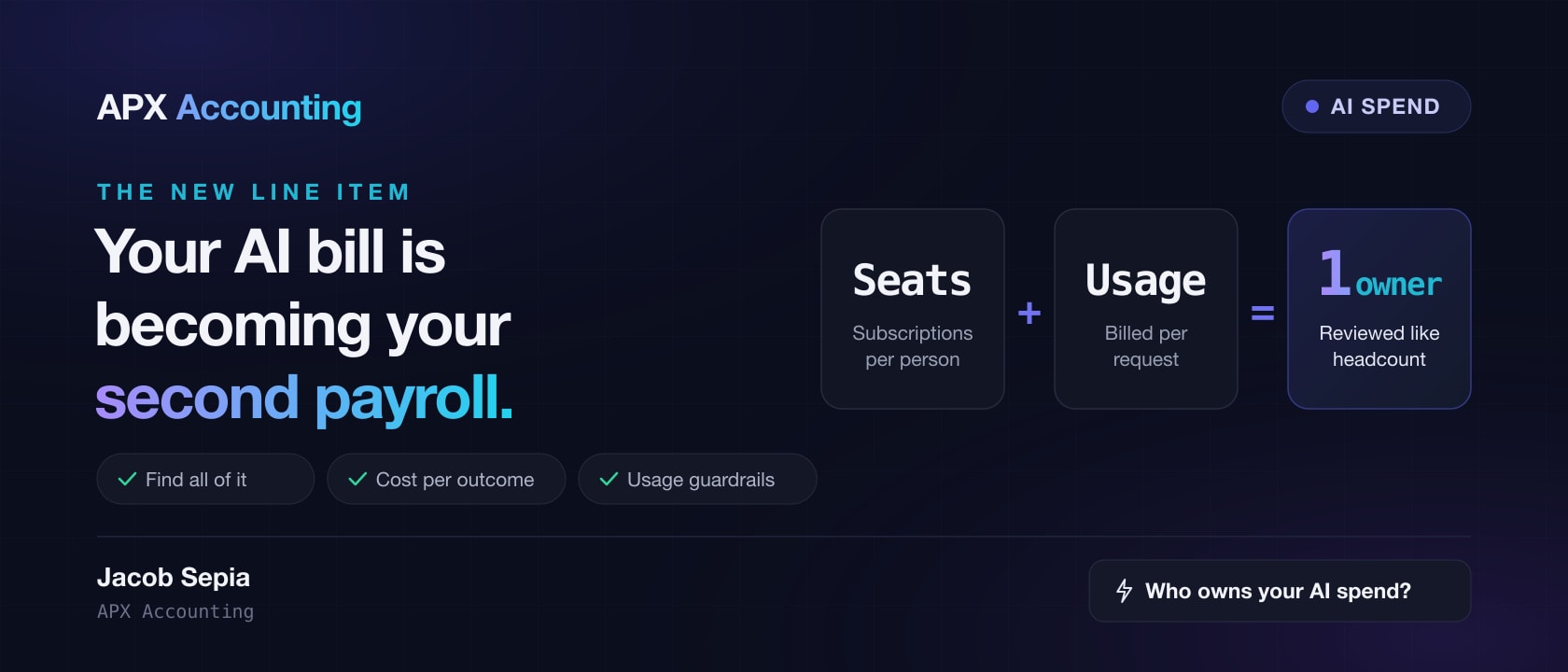
Your AI bill is quietly becoming your second payroll.
Let me be clear up front: I'm not anti-AI. We use it every day at APX, and it's a big part of why a small team can deliver CFO-level work. I'm anti-mystery-spend. And right now, AI is the least visible spend in most companies.
We've Seen This Movie Before
The pattern is familiar because it's exactly what happened with SaaS a decade ago. A $20 seat here. A pilot there. A team lead puts a tool on the company card because it solves a real problem this week. Nobody approves it, because it's too small to need approval. Then it renews. Then three more people need seats. Then a second team buys a competing tool that does the same thing.
A few years later, the company is spending six figures a year on software nobody audits, and half the seats haven't been opened in months.
AI is following the same path, only faster, for three reasons.
- It's spread across every team. Sales has a prospecting tool. Marketing has a writing tool. Engineering has a coding assistant and API usage. Operations has an automation platform. Finance has its own. No single budget holds all of it.
- A lot of it is usage-based. Seat pricing is predictable. Usage pricing isn't. An API key wired into a product or an automation can cost $40 one month and $4,000 the next, and nobody notices until the card statement arrives.
- It hides in the books. AI tools land in "Software," "Dues & Subscriptions," "Office Expenses," or an employee's expense report. When it's scattered across four accounts and twenty cards, there is no number to look at.
The Question Almost Nobody Can Answer
Every month I ask founders the same question: what's your total AI spend?
Almost nobody knows. Not roughly, not within 50%. And it's often growing faster than any other line on the P&L.
Try it now. Ballpark your monthly AI spend across every team, every card, and every API. Then go check. The gap between your guess and the real number is the size of the problem.
A Framework for Getting AI Spend Under Control
The fix isn't banning tools. Banning tools just pushes the spend onto personal cards and expense reports, where it's even harder to see. The fix is visibility and ownership.
1. Find all of it
Pull twelve months of company card statements, accounts payable, and expense reports. Search for every AI and software vendor. You'll find tools you didn't know you had, duplicates across teams, and subscriptions belonging to people who left months ago.
Then make it visible going forward. Give AI and automation tools their own expense account, or a dedicated tag, so the total shows up on your P&L every month instead of being scattered across five lines. This is a five-minute change to your chart of accounts, and a bank rule or two makes it automatic: every charge from a known AI vendor gets categorized correctly the moment it hits the bank feed.
2. Give it one owner
Who owns the AI budget? If the answer is "everyone," the answer is no one.
One person should own the list, the renewal calendar, and the monthly number. That doesn't mean one person approves every tool. Teams should still choose the tools that help them work. It means one person can always answer what you're spending, where, and why.
3. Measure cost per outcome, not cost per seat
Seat price is the wrong question. The right question is what you're getting for it.
A tool that saves someone ten hours a month at $500 is cheap. A tool nobody has opened in sixty days at $50 is expensive. A usage-based API that powers a feature your customers pay for might be the best money you spend all year, as long as you know what it costs per customer.
For every meaningful tool, write down the outcome it's supposed to produce: hours saved, tickets closed, leads researched, invoices processed. Then check, quarterly, whether it's producing it.
4. Run the displacement test
Every new tool should displace something: an old tool, an old process, a contractor, or hours of manual work. Ask the question at purchase time and again at renewal: what got cancelled when this got bought?
If nothing did, you didn't adopt AI. You just added spend.
5. Review it like headcount
You wouldn't let headcount grow for a year without reviewing it. Treat AI and software the same way. Keep one list of every subscription with its owner, cost, billing type, and renewal date. Review it every quarter. Cut what isn't earning its place before it renews, not after.
6. Put guardrails on usage-based billing
For anything billed on usage, set spending limits and alerts in the vendor's dashboard. Issue a separate virtual card per major vendor with a monthly cap, so a runaway automation hits a ceiling instead of your bank balance. Keep API keys owned by a company account, not someone's personal login.
A Canadian Detail Most Companies Miss
Many AI vendors are based outside Canada. Under the CRA's simplified GST/HST regime, a lot of foreign digital vendors now charge GST/HST to Canadian customers. If your business is a GST/HST registrant, give those vendors your registration number so they don't charge you the tax in the first place. GST/HST charged by a vendor registered under the simplified regime generally can't be claimed back as an input tax credit, so it becomes a pure cost.
Across dozens of subscriptions, that adds up. It's exactly the kind of leak our HST Audit Recovery review is designed to find.
Where Accounting and Automation Meet
This is a good example of why we built APX around both accounting and technology.
The accounting side is classification and judgment: the right accounts, the right owners, the right questions at renewal time. The technology side is making it automatic: bank rules that tag AI vendors the moment they're charged, a subscription list that updates itself, and a dashboard line that shows your total AI spend every month without anyone building a spreadsheet.
Either half on its own doesn't work. Good categorization without automation decays the minute someone gets busy. Automation without accounting judgment just produces wrong numbers faster.
The Bottom Line
AI is not the problem. Unowned spend is.
The companies that get the most out of AI aren't the ones spending the least. They're the ones who know exactly what they're spending, who owns it, and what it's producing. That takes one owner, one list, one number, and one quarterly review.
If you'd like help finding your real number, our Tech & Automation team can map your stack and set up the tracking so it stays visible. Book a call and bring your best guess. We'll tell you how close it was.