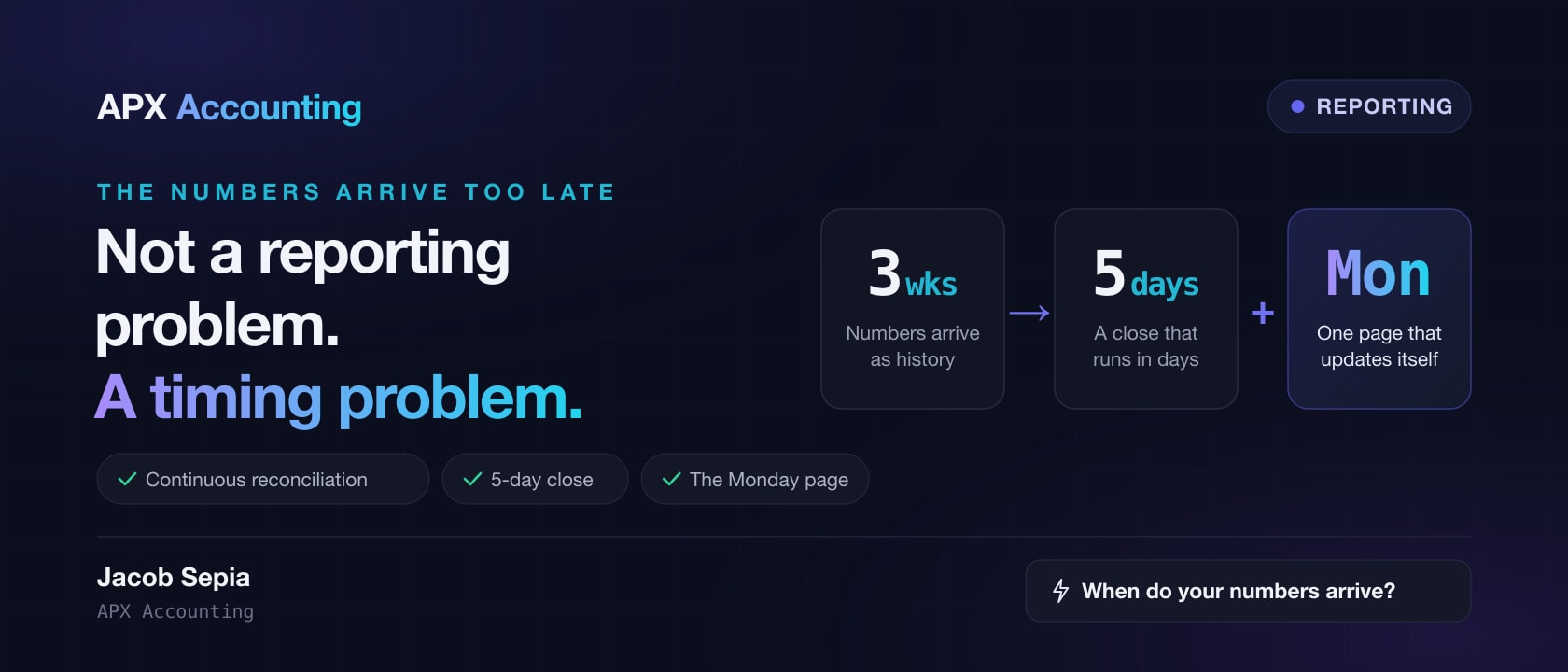
Most small businesses don't have a reporting problem. They have a timing problem.
The numbers exist. They're in QuickBooks or Xero, in the bank feed, in the payroll system, in someone's spreadsheet. But they arrive three weeks after month-end, packaged in a report, by which point the decisions they should have informed have already been made.
If your financials arrive after the fact, they're history. If they arrive on Monday morning, they're a tool.
The fix isn't fancier reports. It's a faster close, and one page that updates itself.
Why the Numbers Arrive Late
A slow month-end close is almost never one big problem. It's a pile of small ones, all waiting until the end of the month to be dealt with at once.
- Manual data entry. Transactions get typed in, or imported from spreadsheets, in batches. Nothing is current until someone sits down to catch up.
- The receipt chase. Half the close is spent asking people for receipts from three weeks ago that they've already forgotten about.
- Reconciliation in one big batch. Every bank and credit card account gets reconciled at month-end instead of as transactions happen, so every error gets discovered at the same time.
- Payment platforms that don't match the bank. Stripe, Shopify, and PayPal deposit net amounts, after fees, refunds, and holds. Someone has to unpick every deposit by hand to record the real revenue.
- Accruals reinvented every month. Without a standard checklist, the same adjustments get rediscovered and recalculated from scratch.
- A review bottleneck. Everything lands on one person's desk in the same three days.
Notice that most of those aren't accounting problems. They're workflow problems, and a lot of them are problems a system can solve.
Stop Saving Everything for Month-End
The single biggest shift is moving from a month-end crunch to continuous accounting: doing a little of the close work every day instead of all of it at the end.
When transactions are categorized within a day or two, accounts are reconciled weekly, and receipts are captured at the moment of purchase, month-end stops being a project. It becomes a review of work that's already done.
That's only possible when the routine work runs on its own. This is where accounting and automation stop being separate things.
The automation layer
- Bank feeds and rules. Transactions flow in daily, and rules categorize the predictable ones (rent, software, utilities, payroll) automatically, to the right account and department.
- Receipt capture at the source. Tools like Dext let your team snap a receipt or forward a bill the moment it happens. The document is attached to the transaction before anyone has to ask for it.
- Payment platform integrations. Tools like A2X break Stripe and Shopify deposits into gross sales, fees, refunds, and taxes automatically, so revenue is recorded correctly without anyone unpicking a deposit.
- Payroll that posts itself. Payroll journals land in the general ledger automatically after every run, already split by department.
- Payables in a workflow. Bills come in, get approved, get paid, and get recorded through a platform like Plooto, instead of being keyed in after the fact.
The human layer
Automation handles volume. It doesn't handle judgment. Someone still has to review what the rules did, catch the transaction that looks right but isn't, book the accruals, think about revenue recognition, and ask why a number moved.
That's the right division of labour. Software does the data entry and matching. Accountants spend their time on review and on the questions software can't answer. When either half is missing, you get either slow books or fast wrong ones.
A Close Calendar That Runs in Days
With the routine work happening continuously, a close of five business days is realistic for most small and mid-sized businesses. A typical calendar looks like this:
- Days 1–2: Final bank and credit card reconciliations (mostly done already), payment platform clearing accounts, and any missing documents.
- Day 3: Accruals, prepaid expenses, deferred revenue, and payroll true-ups from a standard checklist.
- Day 4: Review: balance sheet reconciliations, variance analysis, and anything that moved more than expected.
- Day 5: Financial statements finalized, with commentary on what changed and why.
The point isn't speed for its own sake. Every day you shave off the close is a day earlier that you can act on what the numbers are telling you.
The Monday Page
Here's the part most businesses skip entirely. Even a fast close only gives you a picture once a month. Your business doesn't change once a month.
What owners actually need is one page that updates itself and answers the questions that matter this week. We call it the Monday page. Ours usually includes:
- Cash: what's in the bank today, and where it's headed over the next thirteen weeks.
- Receivables: who owes you, how much, and how old it is.
- Payables: what's due this week and next.
- Margin: gross margin for the month to date, or job margins if you run projects.
- Two or three business-specific numbers: MRR for a SaaS company, backlog for a contractor, inventory weeks on hand for a product business.
One page. No digging. If it takes more than a minute to read, it has too much on it.
Because the books underneath are current, the page is current too. Nobody builds it on Sunday night. It's simply there on Monday morning.
How We Do This at APX
Every APX client gets a live portal, and we built it ourselves. It's our own software, set up around how each client wants to see their business: their metrics, their layout, their level of detail. Clients can log in at any time and see cash, budget against actuals, and a rolling 13-week and 26-week cash flow forecast.
Inside it is a scenario builder. Thinking about hiring? Switch the hire on and see what it does to cash over the next thirteen weeks. Try raising prices, taking on a loan, or losing your biggest customer, and see the result before you commit.
The portal doesn't replace the conversation with your accountant. It makes the conversation better, because you arrive already knowing the questions.
Where to Start This Month
- Measure your close. Count the business days from month-end until you had final numbers last month. Write it down. That's your baseline.
- Find the biggest delay. It's usually one of three things: missing receipts, payment platform deposits, or batch reconciliation.
- Automate that one thing. Not everything at once. The biggest bottleneck first.
- Pick your five Monday numbers. The ones that would change a decision if you saw them every week.
The Bottom Line
Clean books are table stakes. Timely books are what make them useful.
If your financials show up three weeks late, the problem isn't the report. It's everything upstream of it. Fix the workflow, let automation carry the routine work, keep accountants on the judgment calls, and put the numbers that matter on one page that's ready every Monday.
That's what our Financial Reporting and Tech & Automation services are built to deliver. Book a call and tell us how long your close takes today.